
The control layer for plants with distributed energy resources.
Apio EMS holds a physical model of the plant, computes a quarter-hourly dispatch plan for every asset under its operating and market constraints, and executes that plan on site — including when the link to the cloud is down.

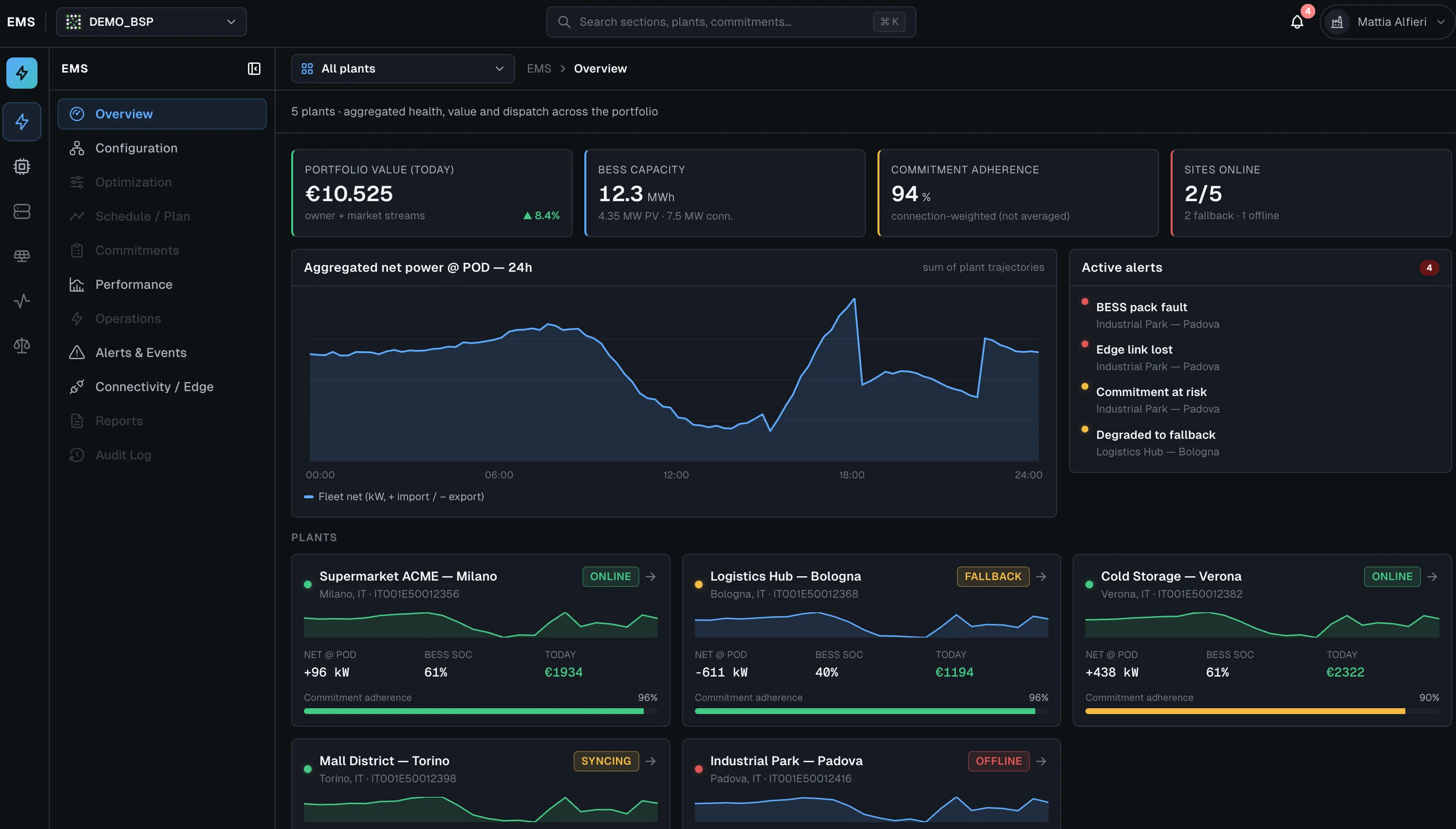
Planning in the cloud, execution on the plant.
Decisions that need forecasts, prices and a full view of the site run in the cloud, on a daily and intraday cycle. Measurement, actuation and protection run on the plant, on a cycle of seconds.
Reference profiles for load and generation, separated by working, holiday and pre-holiday days, updated from measured data.
A dispatch plan at 15-minute resolution for every asset, subject to connection point, asset and market constraints.
EMS Edge reads the meters, issues setpoints and verifies that each one was applied, correcting against measurement rather than assuming.
Without connectivity the plant runs the last valid plan, then a configured fallback policy, then a defined safe state.
A full-fidelity model of the plant.
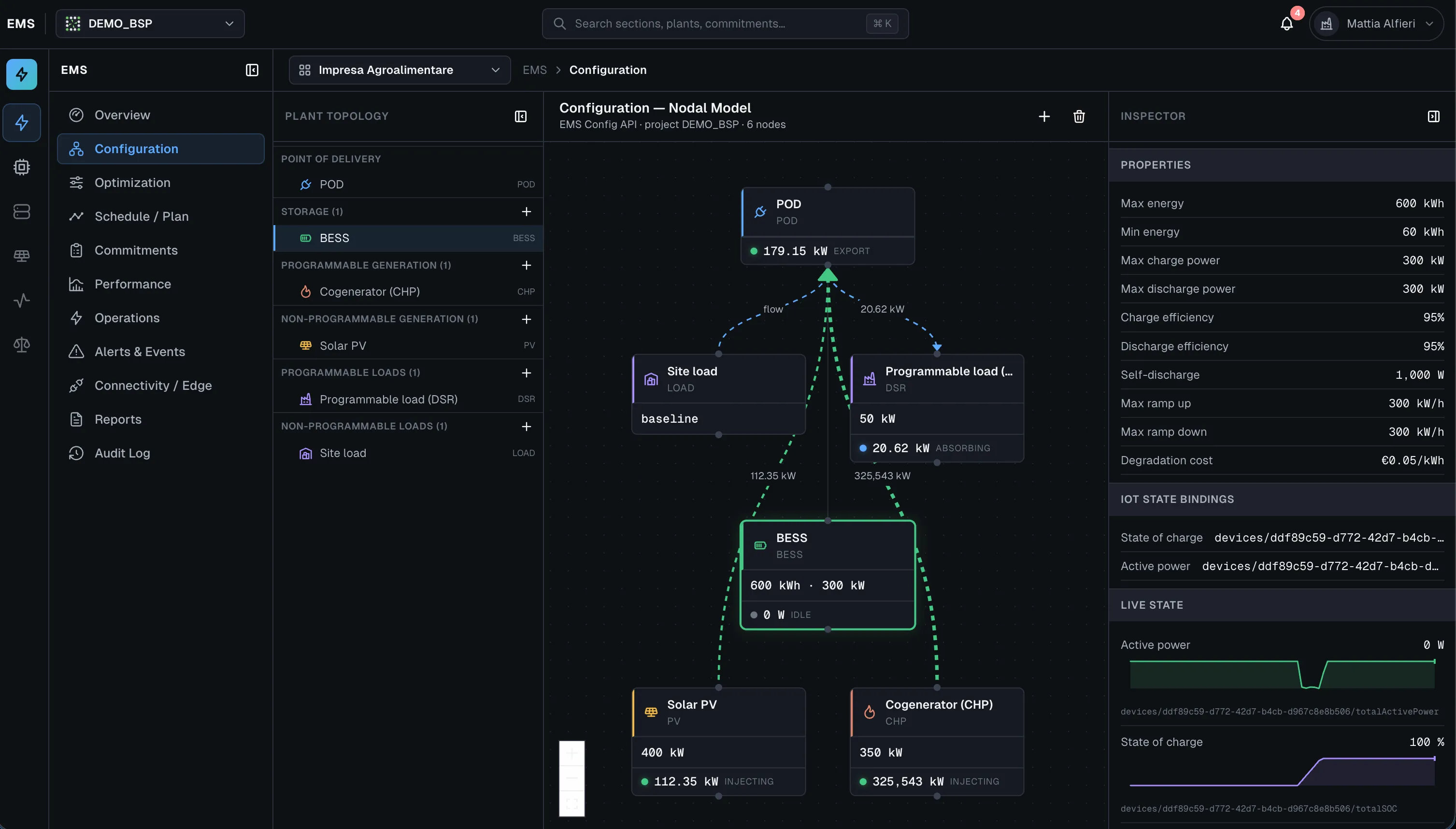
The plant is described once, in a graphical configurator: connection point, storage, generation, CHP units and modulable loads, with the electrical links between them. Each asset carries its technical parameters — capacity, power limits, efficiencies, ramp rates, operating costs, usage windows — and each physical quantity is bound to the device that measures it.
The optimizer, the monitoring views and the market interface all read from this model, so a change to the plant is a change in one place. Assets can declare a fallback profile, which keeps the plan computable when a meter goes missing, and configuration is updated without interrupting operation.
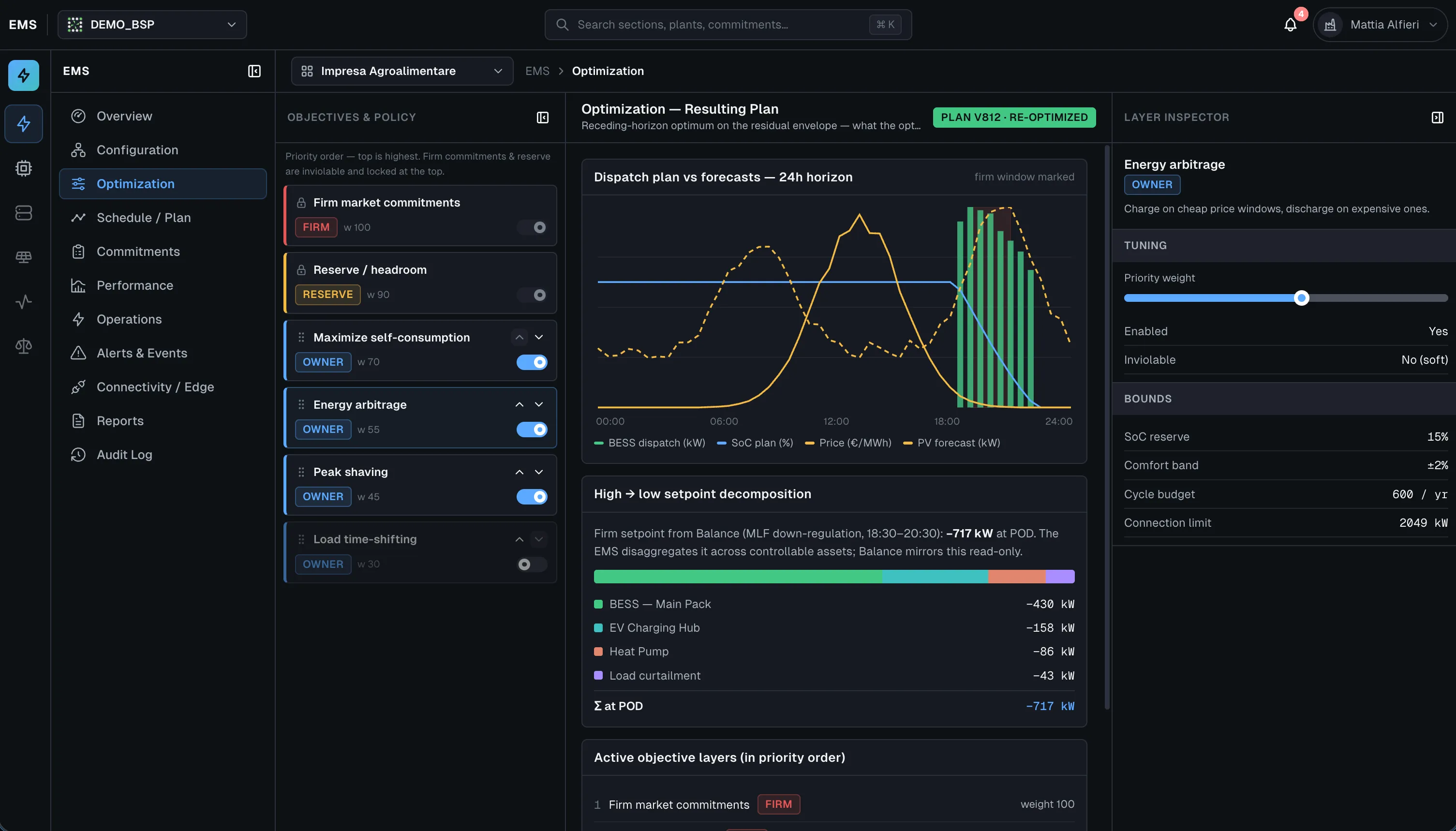
Dispatch under physical and contractual constraints.
The optimizer computes a plan for every asset over the day at 15-minute resolution. Constraints are hard: withdrawal and injection limits at the connection point; capacity, power and round-trip efficiency of storage; technical minimums, ramp rates and marginal costs of generators; energy requirements and time windows of modulable processes.
Objectives are configurable and can be combined:
- —Self-consumption of on-site generation
- —Arbitrage against energy prices
- —Peak shaving on withdrawn power
- —Load shifting into lower-cost bands
- —Battery degradation, priced into the objective so a cycle is taken only when the return covers it
Every plan is stored with the inputs it was computed from, and can be reproduced — the requirement for settlement and audit.
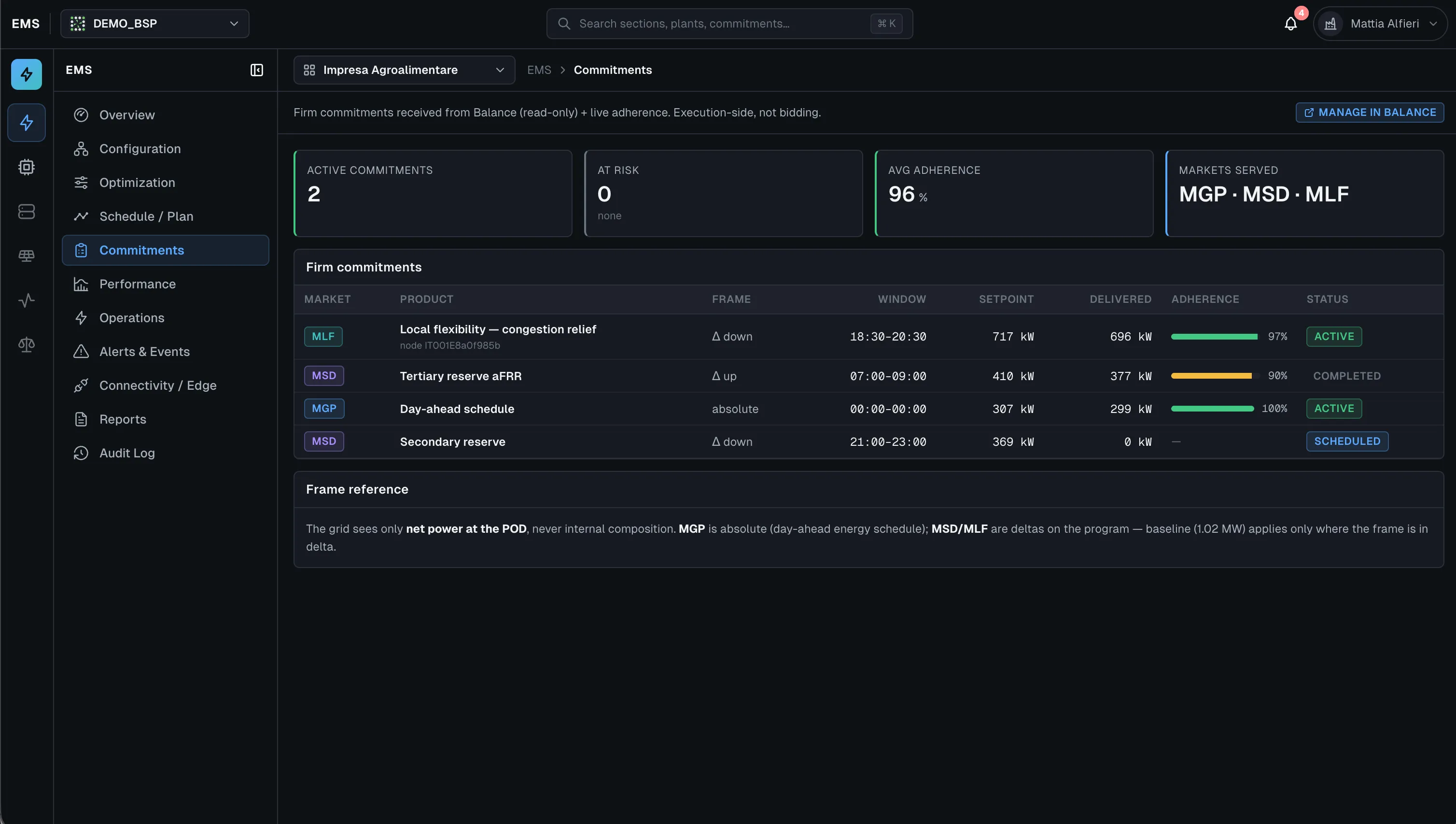
Commitments enter the optimizer as constraints.
Apio EMS computes the flexibility envelope of the plant: the upward and downward power it can sustain in each interval, given its state, its forecasts and the obligations already taken. This is the quantity needed to offer capacity on a market.
Accepted commitments become constraints of the next plan rather than targets alongside it. Delivery is measured against them and the deviation is exposed per interval, which is what settlement and penalty exposure are computed from. Capacity can be held in reserve for expected activations, with the cost of holding it made explicit.
Market schemes — scheduling, dispatching services, local flexibility — differ in parameters rather than in mechanism, so supporting another one is configuration.
Plan against measurement.
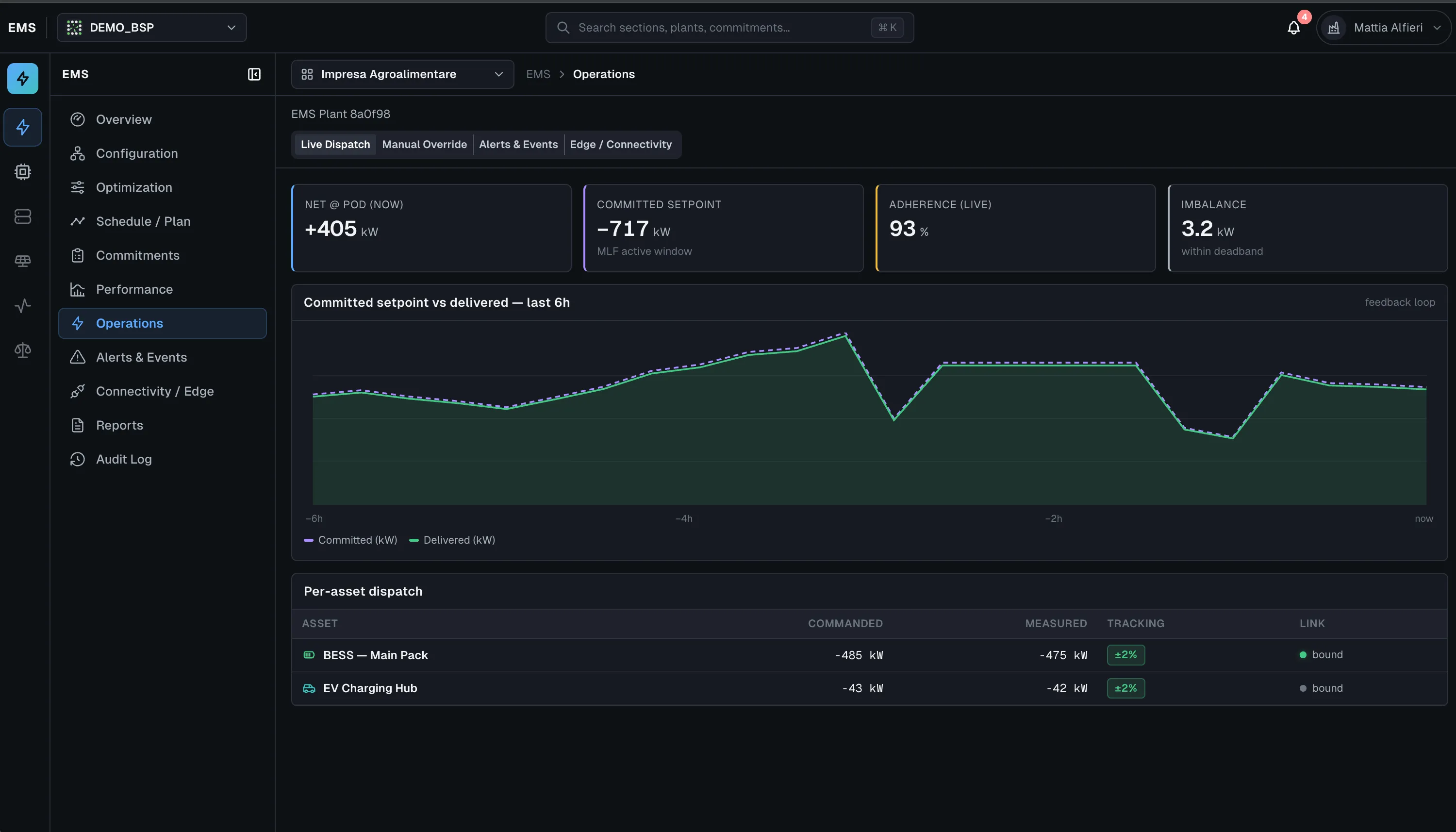
The plant view shows power at the connection point, state of charge and the contribution of each asset, overlaid on the plan in force. Indicators cover energy withdrawn and injected, self-consumption share, peak withdrawal and plan adherence.
The same indicators aggregate across sites, over day, month and year, for operators running a portfolio rather than a single plant.
REST API and OpenAPI specification.
- JSON REST API over the whole model: plants, assets and current state, baselines, envelope and plans
- OpenAPI specification kept in sync with the deployed service
- Multi-tenant by project, integrated with the Apio IoT Platform for devices and measurements
curl "http://api.dev.ems.apio.network/ems/optimizer/v1/projects/$PROJECT_ID/plants/$PLANT_ID/plan?day=2026-09-28"